Showing posts with label classic. Show all posts

Thursday, February 28, 2013

Dixie Deer Classic 2013

Each year around this time I endure an annual pilgrimage that takes me to all corners of the Earth.  I encounter some of the most unique, revered, and feared beasts.  One particular animal stands out amongst all others though.
If a deer hunter, and I mean a hardcore, thinks about hunting 25 hours per day 8 days a week, big buck down dreaming deer hunter were to die and go to Heaven, this place would still surpass anything he could envision.  Whitetails by the hundreds surround you.  The chatter in the air consists of voices telling story after story of deer taken by bow, crossbow, rifle, muzzleloader, and dogs.
There are also the sounds of the ones that got away.  The big one that stepped out just after dark or left just before daylight.  The monster that stared right into the eyes of the hunter as if to dare him to take the shot and consume the hunter with excitement, anxiety, and sheer madness to the point of either not taking the shot or fumbling altogether.  The one that does not induce buck fever, but rather buck plague!
Yes, the Dixie Deer Classic in Raleigh is one of the premiere hunting exhibitions not only in the Southeast, but the whole country.  Too big for just one roof, the DDC as it is commonly called fills up a good portion of the North Carolina State Fairgrounds for a three day extravaganza.
World class guides and outfitters stand at the ready to convince you the next trip of a lifetime is within reach.  Break-out sessions offering instruction covering everything from quality game and land management to how to call turkeys in close are there to enhance your hunting experiences.  Well known and well regarded outdoorsman personalities are there to offer encouragement and share their wisdom as well.
Last year I interviewed Steven Rinella, who is one of the featured guests this year.  Rinella offered me an advance copy of his book Meateater before its national release.  A great book that told the story of what hunting means to him.  While he has done some things wrong in the past, his story mirrors most peoples.  He understands the benefits of proper game management through the events in his life.  He recently partnered with the Theodore Roosevelt Conservation Partnership and has become an advocate for proper management to maintain ongoing, sustainable land and wildlife resources.
Another guest will be Tom Miranda.  Miranda is the first person to successfully take all 29 big game species in North America with archery equipment on film.  In the annuls of history, Miranda will be mentioned with other great outdoorsmen of North America that include Davy Crockett, Daniel Boone, Teddy Roosevelt, Art Young, Fred Bear, and Chuck Adams.  Think about it.  Not only did he hunt each species, but he harvested the animal.  He closed the distance enough to take it successfully with a bow.  And he did it while being filmed.  One other thing, they were all trophy sized animals as well.
Looking at both Rinella’s and Miranda’s youth, it seems they could have been brothers.  Both grew up and spent time in the upper Michigan area.  Both fueled their passion for nature through trapping.  They both tried to make a career out of what has become a lost art in today’s world.  Trapping was their entry.  Hunting became their legacy.
Our world now encourages youth to stay inside and use computers for both play, study, and work.  They grew up learning to be self reliant.  Middle schoolers now receive iPads and are taught how to use a calculator, word processor, and spreadsheet.  When I was in school we were taught how to do arithmetic, calculus, and physics with pencil, paper, and often, a very big eraser.
The world has changed.  If we do not build the excitement in both youth and new hunters, the very things we enjoyed growing up and the things that Rinella now fights for will become a distant memory only to be studied in text books.
Shows such as the Dixie Deer Classic and later this summer the Southern Trophy Hunter show in Greensboro can help ignite the fire.  Take someone who has never hunted, whether youth or adult, and look at their eyes as they enter.  You will see the same awe and twinkle that Miranda had as he stalked another record book beast.
The Dixie Deer Classic runs March 1-3 at the North Carolina State Fairgrounds in Raleigh, NC.

Wednesday, March 14, 2012

A Little Hardware from the Dixie Deer Classic

This will not be my normal post, that will come Thursday.  But I did want to share a little hardware I recieved from the Dixie Deer Classic and North Carolina Bowhunters Association banquet.

Largest Beaver taken by bow 2011

Second Place Best Photo
Yes, I am in the photo and I took the photo.  Amazing how those timers work! (It did take a few tries to get the shot I wanted...)

Thursday, March 8, 2012

Trophy vs Experience

Is it the experience, or the trophy? 

This weekend I spent the better part of the days waiting on huge antlers to cross the curtain at the Dixie Deer Classic in Raleigh.  Saturday kicked in with, now this is hear-say, a record attendance for one day.  Friday and Sunday were not bad, but Saturday forced show goers to walk shoulder to shoulder at times.

While the number of heads to be scored seemed slower than past years, the quality was certainly there.  A scorer at a trophy show such as the Dixie Deer Classic is given some basic training, and usually paired with another experienced scorer during his first event.  Typical racks rarely present a problem.  Cut and dry measurements are taken in which the main issues are usually mistakes in adding fractions or judgments on whether something is a point or not and whether the measurement on the ruler should be rounded up or down an 8th of an inch.
Steven Patterson, Bill Howard, Cole Carr, and Amanda Carr
scoring at the Dixie Deer Classic in Raleigh, NC.
Photo by Ryan Miller
For non-typical racks, things can be a little trickier.  Often, the ones with a lot of ‘junk’ are left to the brave souls willing to attempt what amounts to a tedious, and time consuming ordeal.  Properly trained scorers usually make the right calls on these interesting and challenging antlers.  Then, there are some that require judgment calls that can affect the overall scores greatly.  Without getting to deep in the science, maybe even art, of scoring tough antlers, scorers take it very seriously and often recruit help from other trained scorers for their opinions as well.  Boone & Crockett and Pope & Young trained scorers take on the difficult, and potential record book mounts with passion that is often equal to the same passion the hunter exudes on his trophy quest.  Accuracy is first and foremost the top priority in order to properly honor the game animal.

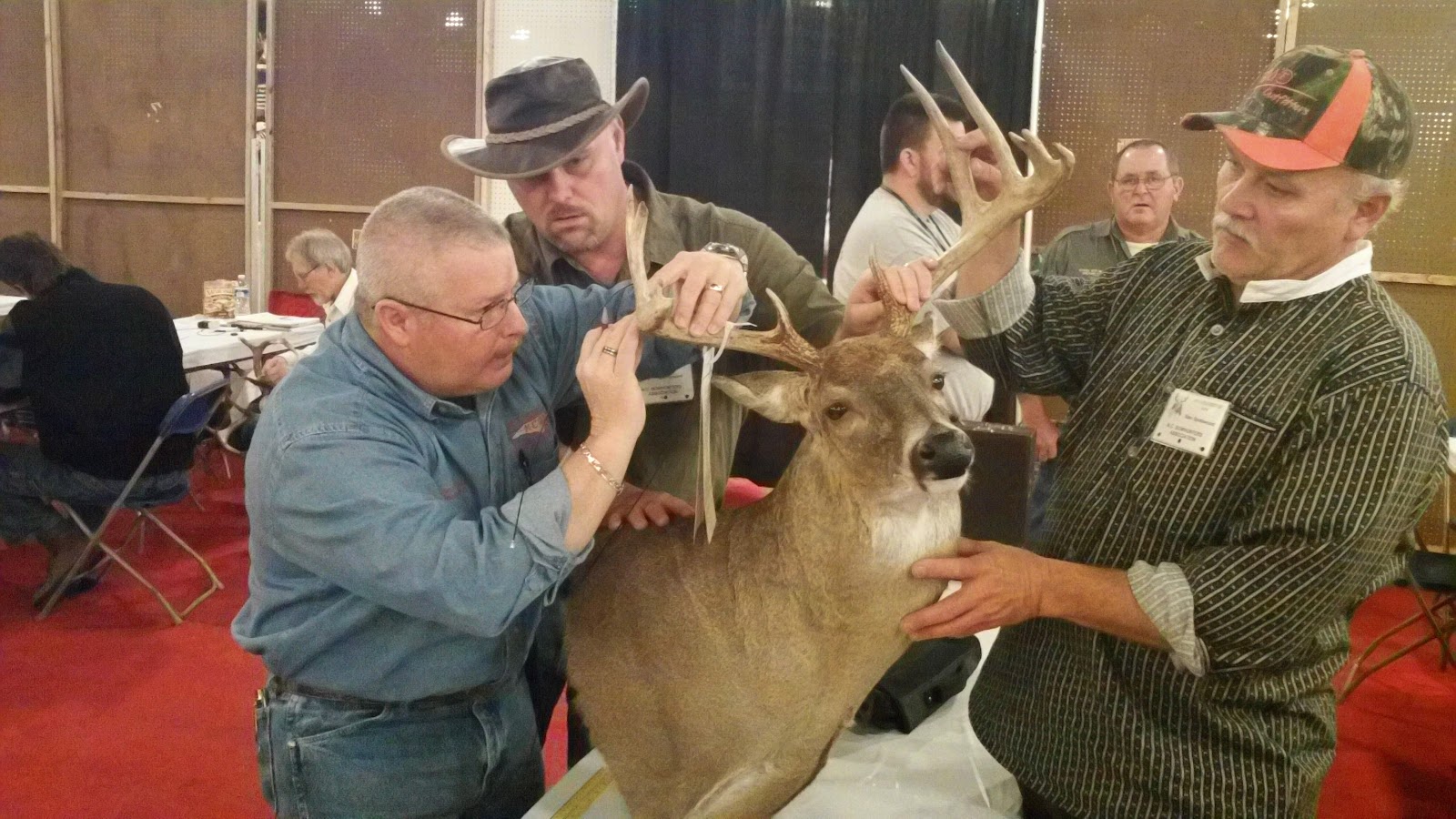
Now to answer the question from the beginning of this column.  Sunday, a hunter was dissatisfied with the score received on his deer.  In order to assure proper measurements were taken, not only did another scorer volunteer to re-score the trophy, but a panel of scorers worked together on the deer.  The deer was mounted in a beautiful half body pose.  The rack, still in velvet as the deer was taken early in the season, had what appeared to be a split in the main beam of the right antler.  This is where the judgment call came into play.  If one part of the split was taken as the main beam over the other, it could sway the official score by a rather large sum.  My opinion was also the opinion of other more experienced scorers, and resulted in a lower score.  The hunter was visibly disappointed.

But my response was it was a beautiful deer, an outstanding example of taxidermy, and a trophy that could and should be valued for a lifetime.  Couple that with the actual experience of not only seeing such a wonderful animal in the wild, but successful in the harvesting of that animal, and there should be no disappointment what so ever.  If we only hunt for the trophy, the experience means less.  However, if we hunt for the experience, then the trophy means much more.

Thursday, March 10, 2011

Men are silly

“Men are silly.  Can’t you just look at a deer and see which one is bigger?”
James Atkins, Bill Howard, and Stan Spotswood measuring
a bowkill at the 2011 Dixie Deer Classic in Raleigh, NC.
That was the question my wife gave me when I left to go to the Dixie Deer Classic in Raleigh this last weekend.  I was one of many volunteers scoring deer for the show.  It posed a good question, and I had to think about it a little.  If the numbering system was used correctly, I would say there were some 700 plus trophies turned in to be scored.  It kept the volunteers busy for the most part.  I started out working with Mr. James Atkins, a fellow member of the North Carolina Bowhunter’s Association and an officer with the Raleigh Police Department.  James was training to become an official scorer with the NCBA, and the process includes measuring as many antlers as you can.  Of course, he could have had a better teacher, as I skipped a whole section on our first deer we scored.  Luckily James was wise enough to figure out I was NOT a great teacher, and asked about the missed section on the second deer, allowing me to humble myself to the officials with the Wake County Wildlife Club and ask for the deer back to be re-scored.  James and I came to know each other pretty well through the show, and it once again proves the camaraderie that forms between people who love the outdoors.
Back to the question though; are we really that competitive to find out whose is bigger?  Well the answer is no.  The scoring of a deer involves many measurements, lengths of the antlers, circumference of the antlers (measured at different locations), and length of the tines.  The score we get does give an indication of how big the deer’s antlers are, but the reason we score is to see what it takes to make a ‘perfect’ rack.  Deer antlers get deductions for abnormal or missing points and differences in lengths and circumferences of the antlers.  These deductions are often what determine whether a deer will make it in the record book or not.
Usually a hunter will tell of how many points his deer has and his spread (the greatest inside distance between the antlers).  But this does not tell the whole story.  If someone took an 8 pointer, was it 4 points on each antler placed symmetrically, or was it more like a 6 pointer with 2 small points sticking haphazardly out?  What we are attempting to accomplish is perfection, an 8 pointer with 4 points on each side, each of the same length, out of the same spot.  Michelangelo should not be able to paint one better.  A ‘perfect’ 8 will be just as nice looking as a ‘perfect’ 12 pointer, and look better than a 13 pointer with 9 points coming off one side.
So while the higher score usually means the deer was bigger, it also means the deer was closer to perfection in relation to its size (most of the time).  It’s a good thing women do not have an elaborate system scoring men.  After working the show all weekend, I would hate to see the score my wife would give me.
By the way, I would have to give my wife a ‘perfect’ 10 for her understanding and watching the home front (and that’s not by the antler method)…


Bill Howard is a Hunter Education and Bowhunter Education Instructor , a Wildlife Representative and BCRS Program Chairman for the North Carolina Bowhunters Association, and an avid outdoorsman.  Please forward any pictures or stories you would like shared to billhowardoutdoors@gmail.com.